

Iuliana Vasiliev
Appointment: Researcher, Senckenberg Biodiversity and Climate Research Centre
Research summary: Her research interest focuses on well dated recordings of paleoenvironmental changes occurring in (restricted) marine water basins during the geological past. Her PhD research tackled the ‘conditio sine qua non’ of Earth Sciences: the age control. I was using an integrated stratigraphy approach (magnetostratigraphy, cyclostratigraphy, 40Ar/39Ar dating), resulting in the revised time-scale for the Paratethys domain (the ancient sea of Eurasia). She identified magnetofossil greigite uniquely produced by magnetotactic bacteria, as an essential component for reliable magnetostratigraphic dating in fresh-brackish water systems. An important topic was to quantify the paleoenvironmental changes within the Dacian basin determining 87Sr/86Sr ratios as proxy for continental water input. Subsequently, she took another path by using organic geochemistry as another working tool. The δ13C and δ2H ratios of molecular biomarkers (n-alkanes and alkenones) measured at multiple locations gave excellent results. She found out that, at the end of the Miocene, the Black Sea was subject to severe drought with extreme evaporation taking place that led to its water level draw.
Her focus oriented to the extraordinary Messinian Salinity Crisis, an event caused by extreme evaporation in the Mediterranean that generated its water level drawdown. In other words, the Mediterranean dried out, at a severity that surpassed even the worst predictions of future climate change. To quantify the dramatic environmental changes associate to this event she uses a combination of sea surface temperatureestimates based on biomarkers and δ18O on foraminifera to calculate paleosalinities at multiple locations in Mediterranean during the Messinian (7.24- 5.33 Ma).
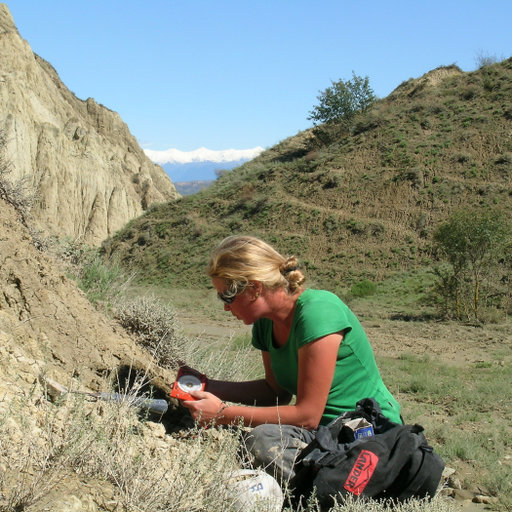
To summarize, she is scientifically tailored to a multidisciplinary approach. She took the chance of developing extended fieldwork experience (in Romania, Russia, Azerbaijan, Ukraine, Italy, Spain, Croatia, Serbia, Armenia, Greece etc) that, by now, is matched by equally sized laboratory practice.
 English
  Greek
Greek