


IEM.1-4 Taxonomy and Applications of Benthic Foraminifera
Instructors: M. Triantaphyllou; M. Dimiza; O. Koukousioura; E. Skampa; M. Langer.
Guest Lecture: Applied Biostratigraphy (M. Bidgood, E.Sheldon, M. Simmons, M. Wakefield)
SEMESTER: 1st
LEARNING OUTCOMES
The course deals with the study of benthic foraminifera, namely their biology and life cycle, ecological and morphological characteristics, main principles of identification, description, and classification and also their applications to biostratigraphy and (paleo)environmental reconstructions.
CONTENT:
Theoretical content (lectures).
- Classification of Foraminifera. Brief history of foraminiferal research, General classification based on the approach by Loeblich and Tappan (1964)
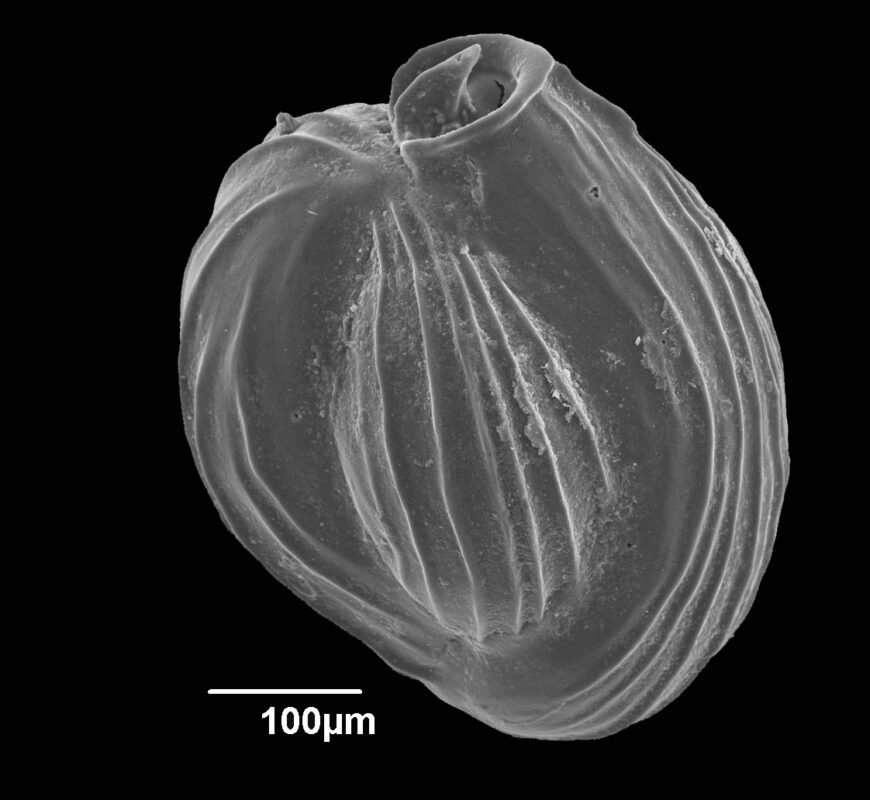
- Test Morphology. Morphological features and descriptive terminology: wall structure and composition, chamber arrangement and shapes, apertures and foramina, sutures, ornamentation, test growth. Species morphological descriptions of major foraminiferal groups (agglutinated, hyaline, porcelaneous)
- Living Foraminifera. The cell, reproduction and life cycle, mode of life
- Distribution & Ecology. Foraminiferal assemblage characteristics concerning their environment: assemblage structure, species richness and diversity, distribution patterns The flux of organic carbon and oxygenation. Benthic foraminifera microhabitats
- Benthic foraminifera in the Mediterranean Sea. Species composition, abundance and bathymetric distribution in relation to environmental factors
- Larger Benthic Foraminifera (LBF) – Biogeography & Stratigraphy. Evolutionary changes in response to significant environment/climate changes in the geologic past, Recent invasions and expansion of larger benthic foraminiferal populations in higher latitudes as examples of adaptation to climatic warming
- LBF Biostratigraphy and biozonal schemes
Β. Practical exercises:
- Applications and case studies in LBF Biostratigraphy
- Industrial Applications
BREAKDOWN OF WORKLOAD
| Activity | Semester Workload (hours) |
| Face to face (in lectures and practical exercises) | 39 |
| Using computers, tablets, smartphones and specialized software (in lectures and practice exercises) | 10 |
| Laboratory exercises | 39 |
| Questions and Answers | 10 |
| Homework – includes preparation for final examinations. | 27 |
| Total | 125 |
STUDENT EVALUATION/GRADING
The evaluation process is conducted in English, either with progress in separate sections of the material or with the final examination of the whole material and includes:
I. LECTURES (50%)
- Oral Examination and/or
- Written exam with short answer questions and Multiple choice test and/or
- Written examination with extended answer questions and/or
- Scientific presentation in a specific topic related to the subject of the course
II. PRACTICAL EXERCISES (50%)
- Written examination with exercises and problem solving
SUGGESTED LITERATURE
- Cimerman, F., Langer, M.R., 1991. Mediterranean foraminifera. Academia Scientarium et Artium Slovenica, Dela, Opera 30, Classis IV, Historia Naturalis, pp. 118, pls 93.
- Kaminski, M.A., 2005. Foraminifera. In: Selley, R. C., Cocks, L.R.M., and. Plimer, I. R., eds., Encyclopedia of Geology, London, Academic Press, p. 448–453.
- Langer, M.R., Silk, M.T., Lipps, J.H., 1997. Global ocean carbonate and carbon dioxide production: the role of reef foraminifera. Journal of Foraminiferal Research 27(4), 271–277.
- Loeblich, A.R., Tappan, H., 1964. Part C. Protista 2. Chiefly “Thecamoebians” and Foraminiferida. In: Moore, R.C. (Ed.), Treatise on Invertebrate Paleontology. The Geological Society of America and the University of Kansas. Lawrence Kansas, 900 pp.
- Loeblich, A.R., Tappan, H., 1987. Foraminiferal Genera and their Classification. Van Nostrand Reinhold. 970 pp + 847 pl.
- Loeblich, A.R., Tappan, H., 1992. Present status of Foraminiferal Classification. In: Takayanagi, Y. & Saito, T (eds), Studies in Benthic Foraminifera. Tokai University Press, 93-102
- Mikhalevich, V.I., 2004. On the heterogeneity of the former Textulariina (Foraminifera). In: Bubik, M. and Kaminski, M.A. (eds.) Proceedings of the Sixth International Workshop on Agglutinated Foraminifera, 8, Grzybowski Foundation Special Publication, pp. 317-349.
- Murray, J.W., 2006. Ecology and applications of benthic Foraminifera. Cambridge University Press, Cambridge, 426 pp.
SCIENTIFIC JOURNALS:
- Marine Micropaleontology
- Micropaleontology
- Revue de Micropaleontologie
- Palaeogeography Palaeoclimatology Palaeoecology
Website:
 English
  Greek
Greek