

ΙΕΜ.1-2 Taxonomy and Biostratigraphy of Calcareous Nannofossils
Instructors: M. Triantaphyllou; E. Skampa; E. Stathopoulou; Ε. Malinverno; Τοm Dunkley Jones
Invited lectures:
Isabella Raffi
The role of calcareous nannofossils for the biostratigraphy and chronology of Cenozoic marine sediments: a review
Jeremy Young
– MIkrotax, Nannotax and included occurrence databases (Neptune, Triton, CASCADE, ForCens) – background, uses, limitations, etc.
– Coccolithophore biomineralisation – how it is reflected in coccolith structure and polarising light images and why it is fundamental to classification and identification of coccoliths.
– the Geological TimeScale and TimeScaleCreator and AgeDepth plots
Cinzia Bottini
Cretaceous Calcareous Nannofossil taxa and Biostratigraphy
SEMESTER: 1st
LEARNING OUTCOMES
The course deals with the study of Calcareous Nannofossils and extant Coccolithophores, focusing on Systematic Taxonomy and Mesozoic-Cenozoic Biostratigraphy training.
CONTENT:
Theoretical content (lectures).
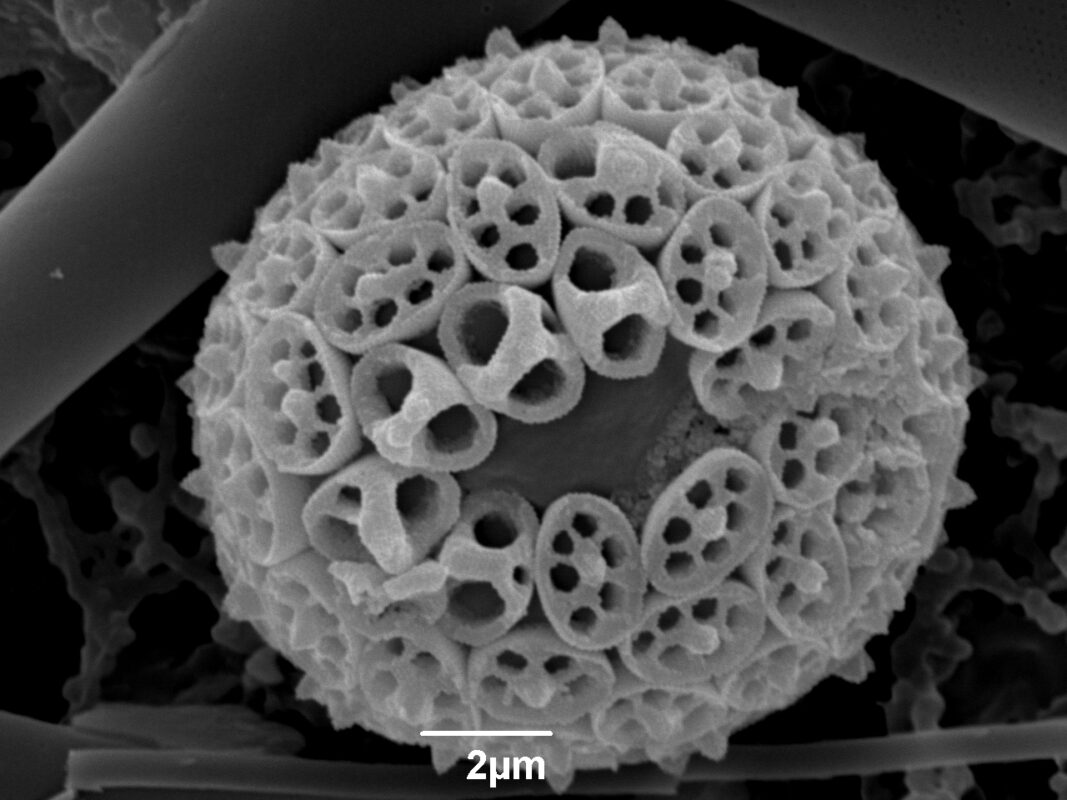
- Introduction. Physiology of Coccolithophores, coccospheres and coccoliths, morphology and life-cycle variations
- Extant Coccolithophores. Taxonomy, Ecology and Biogeography. Biomineralisation and impacts of climate change
- Contribution to sedimentation processes, sediment trap studies and the biological pump
- Updated aspects on classification, phylogeny and species-concepts. Evolutionary history and key stratigraphic intervals
- Calcareous Nannofossils distribution patterns and paleoenvironmental indicators
- Cenozoic Nannofossils groups. Taxonomy and Biostratigraphy.
- Cenozoic biomarkers and biozonal schemes
- Mesozoic Nannofossils groups. Taxonomy and Biostratigraphy
- Mesozoic biomarkers and biozonal schemes
- Applications in hydrocarbon exploration and Industrial Biostratigraphy
Β. Practical exercises:
- Sampling and preparation techniques.
- Quantitative biostratigraphic methods and statistical treatment of data
- Comprehensive microscope lab sessions
- Coccolithophore study using the Scanning Electron Microscope (SEM)
- Calcareous Nannofossils study under the Light Microscope (LM)
- Biostratigraphic exercises and hands-on applications
BREAKDOWN OF WORKLOAD
| Activity | Semester Workload (hours) |
| Face to face (in lectures and practical exercises) | 39 |
| Using computers, tablets, smartphones and specialized software (in lectures and practical exercises) | 10 |
| Laboratory exercises | 39 |
| Questions and Answers | 10 |
| Preparation for final examination and/or project presentation | 27 |
| Total | 125 |
STUDENT EVALUATION/GRADING
The evaluation process is conducted in English, either with progress in separate sections of the material or with the final examination of the whole material and includes:
I. LECTURES (50%)
- Oral Examination and/or
- Written exam with short answer questions and Multiple choice test and/or
- Written examination with extended answer questions and/or
- Scientific presentation in a specific topic related to the subject of the course
II. PRACTICAL EXERCISES (50%)
- Written examination with exercises and problem solving
SUGGESTED LITERATURE
- Agnini, C., Fornaciari, E., Raffi, I., Catanzariti, R., Palike, H., Backman, J. & Rio, D. 2014: Biozonation and biochronology of Paleogene calcareous nannofossils from low and middle latitudes. Newsletters on Stratigraphy 47, 131–181.
- Agnini, C., Monechi, S., Raffi, I., 2017. Calcareous nannofossil biostratigraphy: historical background and application in Cenozoic chronostratigraphy. Lethaia 50, 447–463.
- Aubry, M.P., 2014. Cenozoic Coccolithophores: Discoasterales. Micropaleontology Press, American Museum of Natural History, New York. 1–400.
- Backman, J., Raffi, I., Rio, D., Fornaciari, E., Pälike, H., 2012. Biozonation and biochronology of Miocene through Pleistocene calcareous nannofossils from low and middle latitudes. Newslett. Strat., 45, 221–244.
- Bown, P., 1998. Calcareous nannofossil biostratigraphy. British Micropalaeontological Society Publication Series, p. 328.
- Bown, P.R., Lees, J.A., Young, J.R., 2004. Calcareous nannoplankton evolution and diversity through time. In: Thierstein H.R. & J.R. Young (Eds), Coccolithophores—From Molecular Processes to Global Impact. Springer Verlag, pp. 481–505.
- Malinverno, E., Dimiza, M. D., Triantaphyllou, M. V., Dermitzakis, M. D., Corselli, C., 2008. Coccolithophores of the Eastern Mediterranean sea: A look into the marine microworld. ION editions, 188 pp.
- Nannotax3 website. Cenozoic and Modern Coccolithophores. Young, J.R, Bown, P. R., Lees, J.A., 2023, https://mikrotax.org/Nannotax3/index.php?id=315
- Perch-Nielsen, K., 1985. Cenozoic calcareous nannofossils. In: H. M. Bolli, J. B. Saunders & K. Perch- Nielsen (eds), Plankton Stratigraphy. p. 427–555, Cambridge University Press.
- Raffi, I., Backman, J., Rio, D., Shackleton, N.J., 1993. Plio-Pleistocene nannofossil biostratigraphy and calibration to oxygen isotope stratigraphies from Deep Sea Drilling Project Site 607 and Ocean Drilling Program Site 677. Paleoceanography 8, 387–408.
- Winter, A., Jordan, R.W., Roth, P.H., 1994. Biogeography of living Coccolithophores in oceanic waters. In: Winter A. & W.G. Siesser (Eds), Coccolithophores, Cambridge University Press, Cambridge, pp. 161–177.
SCIENTIFIC JOURNALS:
- Marine Micropaleontology
- Micropaleontology
- Revue de Micropaleontologie
- Stratigraphy
- Journal of Nannoplankton Research
- Palaeogeography Palaeoclimatology Palaeoecology
Website:
 English
  Greek
Greek